Reviews
Making reputation part of the marketplace
Motorway connects people selling their cars with thousands of dealers competing to buy them. But while sellers could compare offers, they had little visibility into the experience they could expect from each dealer.
Dealer Reviews introduced a new layer of transparency, turning seller feedback into a visible measure of dealer performance. The experience gives dealers insight into how sellers perceive them and creates the foundations for a marketplace where reliability and service quality matter alongside price.
I helped shape the product experience that brought reviews into the dealer journey, making reputation more visible while balancing transparency with fairness.
- Role
- Design Lead
- Product
- Motorway Dealer Reviews
- Platform
- Web desktop & mobile
- Focus
- Strategy, design & trust
The problem
Sellers could compare prices, but not the people behind them.
Motorway's marketplace gave sellers a way to compare dealer offers, but it didn't help them understand how reliably each dealer behaved after winning a vehicle.
Some dealers offered a great experience, communicating clearly and honouring their bids. Others engaged in unfair price reductions, known as chipping, or cancelled transactions after winning. Despite these differences, dealers competed on largely equal terms.
This created problems on both sides of the marketplace:
- Sellers had limited information to judge dealer reliability before accepting an offer.
- Good dealers struggled to distinguish themselves from competitors who offered a poor experience.
- Motorway relied heavily on internal investigation and enforcement to address problems after they occurred.
The opportunity was to make dealer reputation a meaningful part of the marketplace, helping good behaviour become a competitive advantage rather than relying solely on Motorway to police it.
Research supported the direction. Sellers described looking up dealers independently before accepting offers, while dealers themselves wanted their track records to be recognised.
By January 2026, Motorway had collected more than 14,000 reviews across 2,350+ dealers, providing a substantial foundation for introducing reputation into the product.
The solution
Turning customer feedback into marketplace accountability.
Rather than introducing public ratings immediately, we took a phased approach: first giving dealers visibility of their own performance, then exploring how reviews could help sellers make more informed decisions.
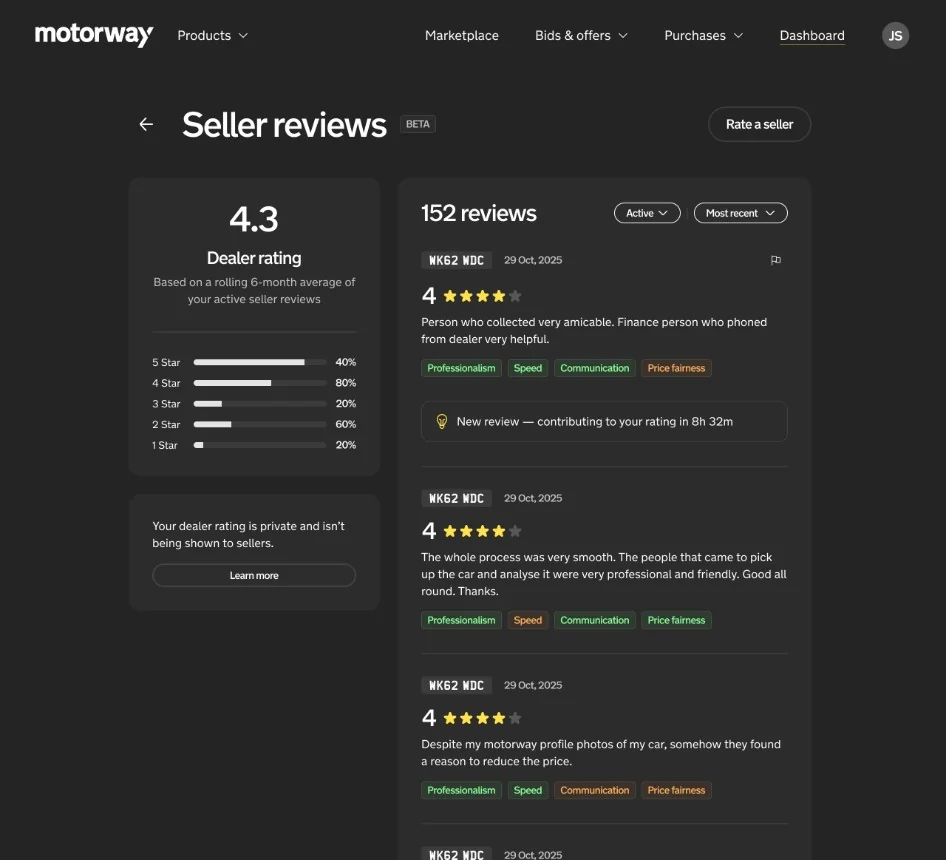
The initial experience brought review scores and written feedback into the Dealer Performance Dashboard. Dealers could understand how sellers rated them, identify recurring issues and challenge feedback they believed was unfair.
This created three core principles for the experience:
Make reputation visible.
Bring existing seller feedback into the dealer's day-to-day product experience, making performance easier to understand and monitor.
Make feedback actionable.
Go beyond a single star rating by showing review distributions and written comments, helping dealers understand what influenced their scores — from price fairness to communication and professionalism.
Build trust through fairness.
Introduce a structured process for challenging reviews that might be inaccurate or reflect issues outside a dealer's control. Transparency would only work if dealers trusted the system itself.
The longer-term vision was to bring reputation into the seller's offer comparison, allowing sellers to consider dealer quality alongside price.
The design & key decisions
Designing a reputation system people could trust.
01. Put reviews where dealers already manage performance
The Dealer Performance Dashboard provided a natural home for reviews. By integrating feedback into an established destination, reputation became part of the existing dealer experience rather than a disconnected feature.
02. Make the score explainable
A star rating alone tells dealers how they're performing, but not why. Showing the distribution of ratings alongside individual written reviews gave dealers more context and clearer opportunities to improve.
Feedback could highlight patterns such as communication, professionalism, speed and perceived price fairness. This made reviews more useful as a tool for improvement, rather than simply a judgement.
03. Design for fairness, not just transparency
Introducing reviews creates an important tension: feedback needs to be visible enough to influence behaviour, but credible enough that both sides trust it.
Dealers needed a way to flag reviews they believed were invalid — for example, when feedback reflected a Motorway process issue rather than dealer behaviour. The experience therefore needed to account for review challenges and the possibility that feedback might be upheld, removed, flagged for investigation or updated.
04. Treat seller-facing ratings as a separate design challenge
The next stage explored showing review scores and review counts alongside the top three offers at the end of an auction.
This would give sellers another way to evaluate their options, potentially allowing them to choose a more reliable dealer over a slightly higher offer. It also created a potential incentive for dealers to improve their behaviour.
Crucially, this was a hypothesis to test, not an assumed outcome. The initial seller-facing experiment was designed to investigate whether visible quality signals could increase offer acceptance.
Iteration & delivery
From collected feedback to a working product experience.
The challenge wasn't simply creating a reviews interface. It was turning an existing source of customer feedback into something useful within Motorway's marketplace.
The work progressed from collecting reviews after sales to surfacing them in the Dealer Dashboard, supported by the functionality needed to make the system usable and credible.
A phased rollout helped the team introduce transparency progressively, learn how dealers responded and understand the operational implications of allowing reviews to be challenged.
This was particularly important because the system needed to work at scale. A successful experience had to give dealers meaningful feedback without creating an unmanageable burden for the teams responsible for investigating disputes.
The broader product direction was to evolve reviews from a reporting feature into a marketplace signal: one that could influence dealer behaviour and eventually help sellers make more confident decisions.
Outcomes & learnings
Making dealer reputation visible for the first time.
The Dealer Reviews ecosystem launched as a significant delivery for the Dealer Engagement team in Q3 2026, giving dealers visibility of their performance and establishing the foundations for reputation to play a larger role across the marketplace.
Key results and context
- 14,000+
- Reviews
- Seller feedback collected across more than 2,350 dealers by January 2026.
- 4.4 out of 5
- Average dealer rating
- In the review data at that point.
- 8
- Customer-facing improvements
- Delivered by the Dealer Engagement team in Q3, alongside three internal improvements; the Reviews Dashboard and supporting features were among them.
The launch established the infrastructure for a more transparent marketplace. The next step was to test whether making dealer quality visible to sellers would influence offer acceptance, and whether reputation could encourage better behaviour over time.
Those outcomes were still hypotheses to validate, rather than proven results of the initial dashboard launch.
What I took away
This project reinforced that trust is not created by adding a rating to a screen. It comes from designing the rules, information and processes around that rating so that people understand it, believe it and can act on it.
The challenge was to balance transparency with fairness, while considering how a change in one part of the marketplace could influence behaviour elsewhere.
By bringing seller feedback into the product, we took a step towards a marketplace where reputation could become part of the decision-making process — helping sellers make more informed choices and giving good dealers a way to stand out.